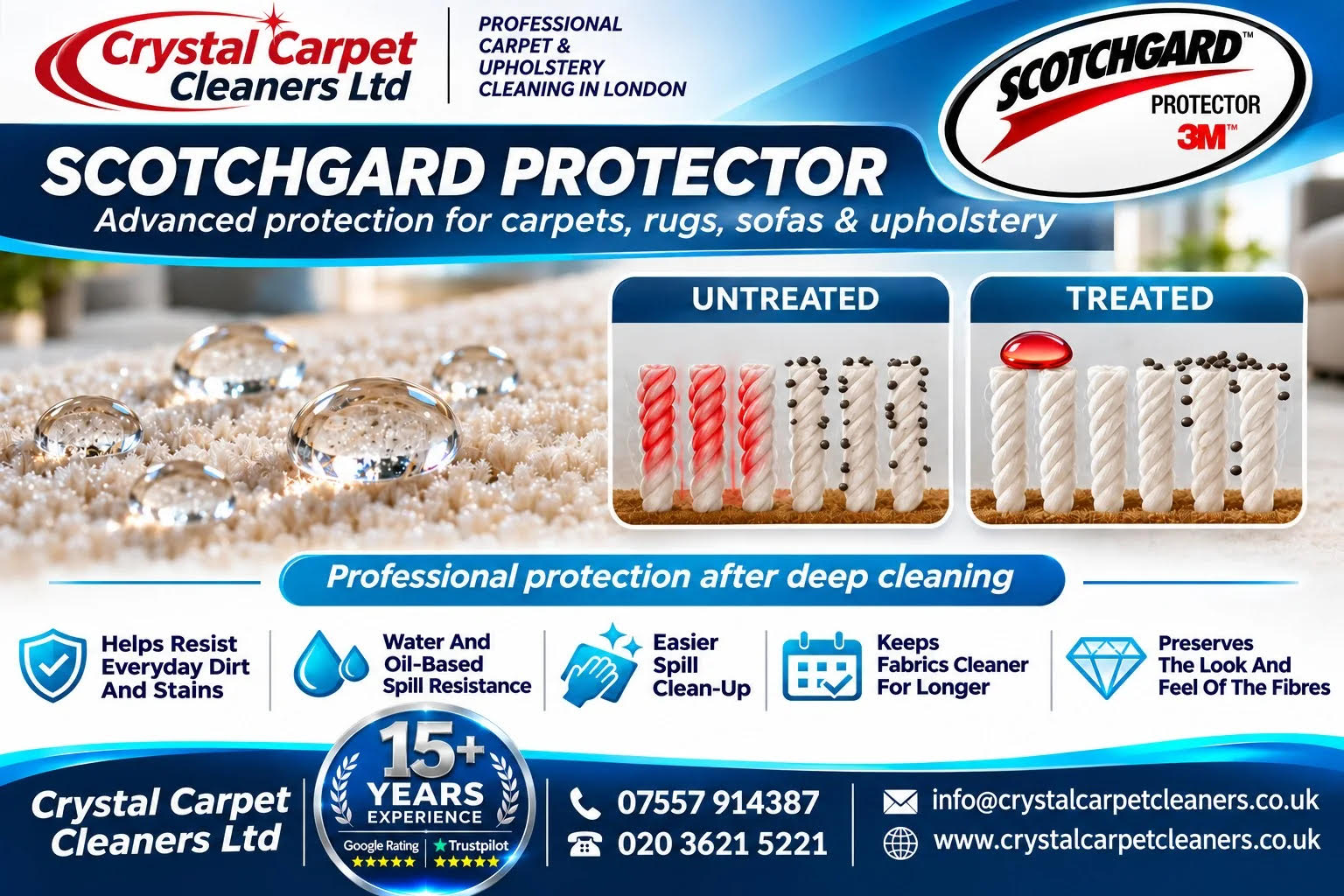
Scotchgard upholstery protection can be worth considering if your sofa regularly faces spilled drinks, sticky fingers and muddy paws. It helps certain fabrics repel liquids, giving you more time to deal with accidental spills before they soak into the upholstery.
However, it will not make your sofa completely stain-proof, prevent pet scratches or eliminate the need for cleaning. Whether the treatment is worthwhile depends on your sofa’s fabric, your household’s habits and how much you are prepared to spend on maintaining it.
How Does Scotchgard Upholstery Protection Work?
Scotchgard upholstery protection is a fabric treatment designed to help certain upholstered surfaces resist liquid penetration and staining.
When applied correctly to a compatible material, the protective treatment creates a repellent effect on the fabric fibres. Instead of immediately soaking into the upholstery, some liquids may form droplets on the surface, making them easier to blot away.
This can be particularly useful on fabric sofas that are used throughout the day.
However, the treatment does not create an impermeable barrier. Liquids may still penetrate the fabric, particularly when left unattended, rubbed into the material or applied in large quantities.
The results also depend on the exact protective product, the fabric construction and whether the treatment has been applied according to the manufacturer’s instructions.
Fabric Protection Is Different from Fabric Cleaning
Cleaning removes dirt, residues and certain stains that have already accumulated.
Protective treatment, by contrast, is intended to reduce the likelihood of some future spills becoming difficult stains.
A sofa can have protective treatment and still become dirty through everyday use. Dust, skin oils, food particles and pet hair continue to accumulate, so regular maintenance remains necessary.
For this reason, upholstery protection should be viewed as an additional preventive measure rather than a replacement for professional upholstery cleaning.
What Are the Benefits for Families with Children and Pets?
The main advantage of Scotchgard upholstery protection is the extra time it may provide when dealing with everyday accidents.
In busy family homes, even a short opportunity to blot a spill before it penetrates the upholstery can make cleaning easier.
Spilled Drinks and Food Stains
Children frequently use the living room for playing, snacking and watching television. Drinks may be knocked over, and food can end up on sofa cushions or armrests.
A compatible protective treatment may help reduce the immediate absorption of some liquid spills, including water-based drinks.
For example, if a glass of water is knocked over, the liquid may remain on the surface long enough to be blotted with a clean, absorbent cloth.
That does not mean every food stain will disappear easily.
Chocolate, oily sauces, strongly coloured drinks and sticky residues may still leave marks. Their removal depends on the substances involved, the fabric and how quickly the spill is treated.
Blotting rather than rubbing is generally the safer first response, provided the sofa’s care instructions permit it.
Muddy Paws and Everyday Pet Mess
Dogs and cats introduce different cleaning challenges.
A dog returning from a walk may leave damp paw marks on the sofa. Cats may transfer dirt, oils and loose fur onto cushions and armrests.
Fabric protection can sometimes make minor liquid-based marks easier to manage, particularly when the contamination is dealt with promptly.
However, it cannot stop pet hair becoming trapped in the fabric or prevent dirt from settling into seams and cushion edges.
In homes where pets move freely between floors and furniture, regular carpet cleaning can help manage accumulated dirt in carpeted areas, while upholstery care addresses the sofa itself. Both surfaces need attention because protective treatment does not remove the dirt pets bring indoors.
Nor should fabric protection be relied upon to prevent urine from penetrating cushions. Pet accidents can involve moisture, odours and residues that reach beyond the surface fabric.
For households with pets, upholstery protection works best alongside regular vacuuming, prompt accident management and appropriate cleaning.
What Can’T Scotchgard Protect Your Sofa Against?
Understanding the limitations is essential before paying for treatment.
Scotchgard upholstery protection does not make a sofa resistant to every type of damage or contamination.
It cannot reliably prevent:
- Scratches and punctures caused by claws.
- General fabric wear, friction or pilling.
- Pet hair and dust accumulation.
- Odours caused by substances penetrating the cushions.
- Every oil-based, coloured or deeply absorbed stain.
- Damage from unsuitable cleaning products.
A protective treatment also cannot reverse existing discolouration or restore worn upholstery.
For example, if a dog repeatedly scratches the same armrest, the fabric may become damaged regardless of whether a stain protector has been applied.
Similarly, a spill that reaches the cushion filling may require specialist attention even when the outer fabric has been treated.
The practical benefit is improved resistance to certain spills, not complete protection against household accidents.
Is Scotchgard Suitable for Every Sofa Fabric?
No. Fabric compatibility is one of the most important considerations before applying any upholstery protector.
Different materials respond differently to moisture, solvents and surface treatments.
The manufacturer’s care instructions should always take priority over general recommendations.
| Sofa material | What to consider before treatment |
|---|---|
| Polyester upholstery | May be suitable for certain protectors, subject to product instructions and testing |
| Nylon upholstery | May be compatible, depending on fabric finish and treatment |
| Cotton upholstery | Absorbency and colour stability require careful assessment |
| Linen upholstery | Potential for water marks, colour changes or texture differences |
| Velvet upholstery | Pile construction and fibre composition can make treatment unsuitable |
| Leather upholstery | Standard fabric protectors are generally unsuitable unless specifically approved |
| Suede upholstery | Requires products specifically intended for that material |
Fabrics That May Be Suitable
Many conventional woven upholstery fabrics can potentially benefit from an appropriate protective treatment.
However, the fibre content alone is not enough to establish suitability.
A polyester sofa, for example, may have a special finish or backing that affects the manufacturer’s recommendations.
Likewise, two cotton sofas may respond differently because of their dyes, construction or previous cleaning treatments.
When Treatment May Be Unsuitable
Particular caution is needed with delicate upholstery, specialist finishes, velvet, leather, suede and fabrics that are sensitive to moisture.
A hidden-area test is important because some treatments can affect colour, texture or appearance.
If the sofa’s care label prohibits the relevant treatment or the manufacturer advises against additional protective coatings, those instructions should be followed.
For expensive or delicate furniture, obtaining a professional fabric assessment before treatment may be the more sensible approach.
Is Scotchgard Safe Around Children and Pets?
The safety of upholstery protection depends on the specific product, how it is applied and whether the manufacturer’s instructions are followed.
Families should distinguish between exposure during application and contact with a fully dried, correctly treated surface.
During application, children and pets should be kept away from the treatment area. Appropriate ventilation is also important, particularly when using spray products.
The sofa should not be used again until the treatment has dried completely and any additional manufacturer-specified waiting period has passed.
It is also important to avoid applying fabric protector near food, children’s toys or pet bedding unless the product instructions explicitly permit that use.
Products sold under the same brand name may have different formulations and safety directions. Therefore, guidance for one product should not automatically be applied to another.
If your child has particular sensitivities, or your pet frequently licks or chews upholstery, consider discussing the intended product with an appropriate healthcare or veterinary professional before use.
A correctly applied treatment may be suitable for normal household use when its instructions allow it, but no protective product should be described as entirely risk-free.
How Long Does Scotchgard Upholstery Protection Last?
There is no single reliable lifespan that applies to every sofa and every protective treatment.
Durability depends on several factors, including how frequently the sofa is used, the amount of friction the fabric experiences, the cleaning methods employed and the exact product formulation.
A sofa in a rarely used guest room may experience less wear than the main family sofa where children play and pets sleep every day.
Repeated cleaning and everyday abrasion may gradually reduce the treatment’s effectiveness.
The manufacturer’s instructions should guide when reapplication is appropriate. Some products recommend renewing protection after cleaning or when liquid repellency has noticeably declined.
However, deliberately pouring liquid onto a sofa to test its protection is unnecessary and may create avoidable staining.
If you are unsure whether the treatment remains effective, ask the product supplier or an upholstery specialist for advice.
Professional Application vs DIY Fabric Protection
Both approaches have potential advantages, but neither guarantees that every sofa will resist staining.
Applying Fabric Protection Yourself
DIY application may be convenient for someone with a suitable sofa who is comfortable following the product instructions.
It also allows you to purchase the treatment separately from professional cleaning.
However, the process requires attention to fabric compatibility, ventilation, preparation, application technique and drying conditions.
Applying too much product, spraying unevenly or treating an unsuitable material may lead to disappointing results or damage.
DIY treatment should never be used as an experiment on expensive or delicate upholstery.
Choosing Professional Treatment
Professional assessment can be useful when the sofa’s fabric is difficult to identify or when the upholstery has already accumulated dirt and stains.
Experienced professional carpet cleaners in London who also work with upholstery may be able to advise on fabric care and whether a particular protective treatment is appropriate.
Before arranging the service, confirm that the provider actually offers the intended treatment and ask which product will be used.
It is also worth checking whether cleaning is required beforehand, how long the sofa must remain unused and whether any limitations or exclusions apply.
Professional application does not remove the need for fabric testing or compliance with the product instructions.
Is Scotchgard Worth the Additional Cost?
For some households, protective treatment can be a sensible additional expense. For others, routine cleaning and washable covers may provide better value.
The decision should be based on how the sofa is used rather than on promises of permanent stain resistance.
| Household situation | Is protection worth considering? |
|---|---|
| Young children frequently eat and drink on the sofa | Yes, if the fabric is compatible and spills are dealt with promptly |
| Dogs regularly jump onto the sofa after walks | Potentially useful for minor liquid-based marks, but not a solution for all dirt |
| Cats scratch the upholstery | Limited benefit because treatment does not prevent claw damage |
| Sofa has removable, machine-washable covers | May be less necessary if the covers are easy to maintain |
| Delicate or specialist upholstery | Only after confirming compatibility |
| Sofa is rarely used | The additional cost may be difficult to justify |
Consider the Full Cost of Ownership
The initial price of treatment is only part of the calculation.
You should also consider whether the protector will require reapplication, whether professional cleaning is recommended beforehand and how often the sofa needs maintenance.
For example, a family with a heavily used fabric sofa may value the ability to deal with certain spills more easily.
By contrast, someone with removable washable covers may prefer to spend their budget on routine maintenance.
It is worth requesting a clear quote and understanding exactly what is included before committing to treatment.
Avoid comparing services solely by price without considering fabric assessment, preparation and product suitability.
How Can You Keep Your Sofa Cleaner for Longer?
Even when upholstery protection has been applied, everyday habits remain important.
Regular vacuuming helps remove loose dirt, crumbs, dust and pet hair before they accumulate.
Pay particular attention to cushion joins, armrests and areas where pets regularly sit.
When spills occur, follow the sofa manufacturer’s cleaning instructions. If appropriate, blot the liquid promptly with a clean cloth rather than scrubbing it into the fabric.
For more substantial contamination, specialist cleaning may be appropriate, particularly when stains or odours cannot be safely addressed using routine household methods.
Other soft furnishings also need regular attention. In living rooms where children play on floor coverings or pets rest on rugs, suitable rug cleaning helps manage accumulated dirt and residues that sofa protection cannot address.
In London homes where living rooms serve several purposes, a consistent cleaning routine can be more useful than relying on one protective treatment.
Washable throws, designated pet blankets and sensible rules around food and drinks can also reduce avoidable staining.
The best approach combines prevention, prompt attention to accidents and cleaning methods appropriate to each fabric.
When Is Sofa Protection a Sensible Choice?
Scotchgard upholstery protection is worth considering when your sofa has a compatible fabric and your household regularly experiences minor spills.
It may make some accidents easier to manage, but it will not prevent every stain, eliminate pet odours or protect against physical wear.
Before paying for treatment, check the sofa’s care instructions, confirm the product being used and compare the cost with alternatives such as washable covers and regular cleaning.
For families with children and pets, realistic expectations and consistent maintenance matter more than any promise of complete protection.
Frequently Asked Questions
No. The sofa should remain unused until the applied treatment has dried completely and the manufacturer’s instructions permit normal use. Drying conditions vary according to the product, application and environment. Keep children and pets away during treatment and drying, and avoid assuming that a surface is ready simply because it feels dry to the touch.
Scotchgard upholstery protection should not be relied upon to prevent urine damage. Some liquid may initially be repelled by a compatible treated fabric, but urine can still penetrate seams, upholstery and cushion fillings. Odours and residues may remain even when the surface appears clean. Prompt attention and suitable cleaning methods are important after pet accidents.
A suitable product applied correctly is generally intended to preserve the appearance and feel of compatible fabrics, but results cannot be guaranteed for every material. Certain finishes, dyes and delicate fibres may react differently. Always follow the product instructions and test an inconspicuous area before treating visible upholstery.
Reapplication may be appropriate after professional cleaning, depending on the product, the cleaning process and the condition of the existing treatment. Some cleaning methods can reduce protective performance. Check the manufacturer’s guidance and ask the cleaning provider whether the fabric is suitable for another application. Avoid automatically retreating a sofa without considering compatibility and previous treatments.